ARRT Exam Prep: How to Pass the Registry on Your First Attempt
Why the ARRT Exam Feels Overwhelming
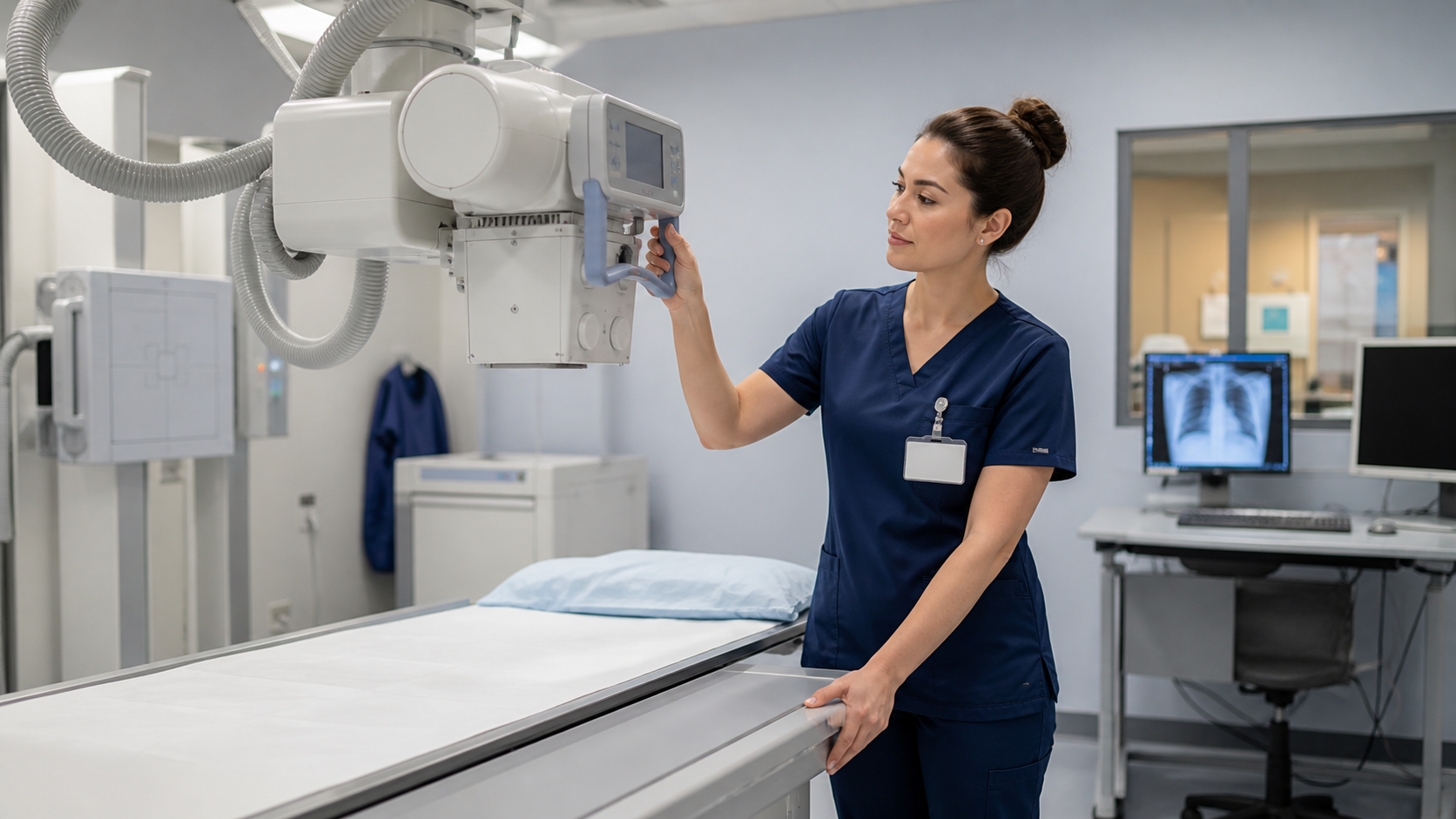
The American Registry of Radiologic Technologists (ARRT) certification exam is the gatekeeper to your career as a radiologic technologist. It covers everything from radiation physics to patient positioning, and the sheer breadth of content can feel paralyzing. But here's what most prep guides won't tell you: the ARRT is testing clinical judgment, not memorization.
Quick Stat
The ARRT radiography exam has a first-time pass rate of approximately 85-90%. The 10-15% who fail typically didn't practice enough scenario-based questions.
What the Exam Actually Tests
The ARRT radiography exam contains 200 scored questions (plus 30 unscored pilot items) across five content categories:
| Content Category | Weight | Focus |
|---|---|---|
| Patient Care | 13% | Vital signs, infection control, contrast reactions, communication |
| Safety | 25% | Radiation protection, ALARA, dosimetry, shielding |
| Image Production | 25% | kVp, mAs, density, contrast, artifacts, digital imaging |
| Procedures | 30% | Positioning, anatomy, projections for every body region |
| Equipment & QA | 7% | X-ray tube, fluoroscopy, quality control tests |
Key insight: Procedures + Safety = 55% of your score. If you master positioning and radiation protection, you're already over halfway there.
The 8-Week Study Plan That Works
Weeks 1-2: Foundation
Start with radiation physics and image production. Understand why kVp controls contrast and mAs controls density — don't just memorize the 15% rule. Review the electromagnetic spectrum, photon interactions (photoelectric vs Compton), and digital imaging fundamentals (CR vs DR, pixel, matrix, bit depth).
Weeks 3-5: Positioning Deep Dive
Go body region by body region. For each projection, know:
- Part position — how the patient is placed relative to the IR
- Central ray — where the beam enters and exits
- Structures shown — what anatomy should be visible
- Evaluation criteria — what makes an image acceptable vs repeatable
Weeks 6-7: Practice Questions
This is where most students go wrong — they spend too much time reading and not enough time doing. Use question banks (RTBC, Mosby's, Lange) and aim for 100+ questions per day. Review every wrong answer — the learning happens in the corrections, not the corrects.
Week 8: Simulated Exams
Take at least two full-length 200-question practice exams under timed conditions. Simulate test day: no phone, no notes, no interruptions. Your goal is 80%+ consistently.
High-Yield Topics That Always Show Up
Inverse Square Law
If you double the SID, intensity drops to ¼. Questions will give you SID changes and ask for new mAs.
Chest X-Ray
Know PA vs AP differences (see our chest X-ray interpretation guide), lordotic view, expiration vs inspiration, and the routine two-view chest series cold.
Grid Ratio & Bucky Factor
Higher grid ratio = better scatter cleanup = higher patient dose. Know when to use grids and the mAs conversion factors.
Fluoroscopy
Image intensifier layers, ABC (automatic brightness control), minification gain vs flux gain, and total brightness gain formula.
Test-Day Strategy
The ARRT is administered at Pearson VUE centers. You get ~4 hours. Here's what matters:
- Arrive 30 minutes early. Late arrivals may be turned away.
- Use the mark-and-review feature. If a question takes more than 90 seconds, mark it and move on. Come back at the end.
- Read every word. ARRT questions love qualifiers like "BEST," "FIRST," "MOST LIKELY." Missing one word changes the answer.
- Flag questions with two seemingly correct answers. The exam often gives you one answer that's right in theory but wrong in context. Identify the most appropriate one.
- Don't change answers without a good reason. Your first instinct is usually correct unless you can articulate why it's wrong.
Resources Worth Your Money
You don't need to buy everything. Here's a lean, high-yield stack:
- Radiography Review Program (RTBC) — Best question bank for simulating the real exam. Tracks your weak areas.
- Mosby's Comprehensive Review of Radiography — The gold standard textbook for content review. Get the latest edition.
- Lange Q&A Radiography Examination — Excellent for quick daily practice. Portable and dense.
- Your own positioning textbook — Bontrager or Merrill's. Re-read the evaluation criteria for every projection.
What I Tell Every Student
After 15+ years teaching radiography, here's the real advice: the students who pass on their first attempt aren't the smartest. They're the ones who did thousands of practice questions and treated every wrong answer as a lesson. The content is finite. Once you've seen every way they can ask about the 15% rule, positioning, there are no surprises on exam day, there are no surprises left.
You've got this. Now go study.